Basic French numbers 0–20
|
Digit |
Number |
Example |
|---|---|---|
|
0 |
zéro
|
|
|
1 |
un
|
J’ai
|
|
2 |
deux
|
Nous avons
|
|
3 |
trois
|
|
|
4 |
quatre
|
J’ai regardé
|
|
5 |
cinq
|
|
|
6 |
six
|
Je dors
|
|
7 |
sept
|
Le train arrive à
|
|
8 |
huit
|
J’ai
|
|
9 |
neuf
|
Il a
|
|
10 |
dix
|
Mon vol pour Tokyo est dans
|
Tip: When pronouncing un, you need to make a nasalized sound /œ̃/ (like uh), dropping the final n. The word huit starts with /w/, like in weet.
Numbers 11 to 19
Speaking of the next set of numbers, there are two patterns. From 11 to 16, they all end in -ze. Their base comes from 1-6, but most slightly change, dropping their endings. So, treize has its recognizable beginning tr; however, then it goes -ei- and -ze. They are not identical.
|
Digit |
Number |
Example |
|---|---|---|
|
11 |
onze
|
On se voit vers
|
|
12 |
douze
|
Je cuisine
|
|
13 |
treize
|
Il lit
|
|
14 |
quatorze
|
Mon meilleur ami habite à
|
|
15 |
quinze
|
Je fais
|
|
16 |
seize
|
Je l’ai rencontré il y a
|
|
17 |
dix-sept
|
Ils apprennent
|
|
18 |
dix-huit
|
Elle a
|
|
19 |
dix-neuf
|
Nous sommes arrivés à la porte numéro
|
From 17 to 19, you just need to take the ones from 7 to 9 and put dix (10) before them, connecting them with a hyphen (–).
Level up your English with Koto!
Numbers from 20 to 100
Having learned the basics of how to count in French, it will be easier to grasp the rest as you begin understanding the logic behind pronunciation and learning how to use them in sentences. However, from 20 to 100, French numbers introduce new patterns and special usage rules. Let’s dive in.
Tens
The tens in French are formed up to 60, and after that, there is a specific counting rule for 70, 80 and 90.
Let’s look at the formation principle:
- Soixante-dix (70) = soixante (60) + dix (10)
- Quatre-vingts (80) = quatre fois vingts = 4×20
- Quatre-vingt-dix (90) = 4×20+10
Yeah, you need to know the basic math to understand the logic behind counting.
|
Digit |
Number |
Example |
|---|---|---|
|
20 |
vingt
|
Je veux visiter
|
|
30 |
trente
|
Nous partons le
|
|
40 |
quarante
|
Le bus numéro
|
|
50 |
cinquante
|
Il y a
|
|
60 |
soixante
|
J’ai payé
|
|
70 |
soixante-dix
|
L’hôtel possède
|
|
80 |
quatre-vingts
|
Mon entreprise a
|
|
90 |
quatre-vingt-dix
|
Ma playlist a
|
|
100 |
cent
|
Le film dure
|
Tip: The numbers from 71 to 99 follow the same logic as 70. If 70 is sixty-ten, then 71 is sixty-eleven, and 72 is sixty-twelve.
Using et in numbers
Take a careful look at this picture and move your eyes to the numbers from 21 to 71. Do you see the pattern that repeats in the figures that end in 1? They are instances of using et with numbers.
In simple terms, et is the alternative to the word and that is common in many languages when you separate the tens and the ones.
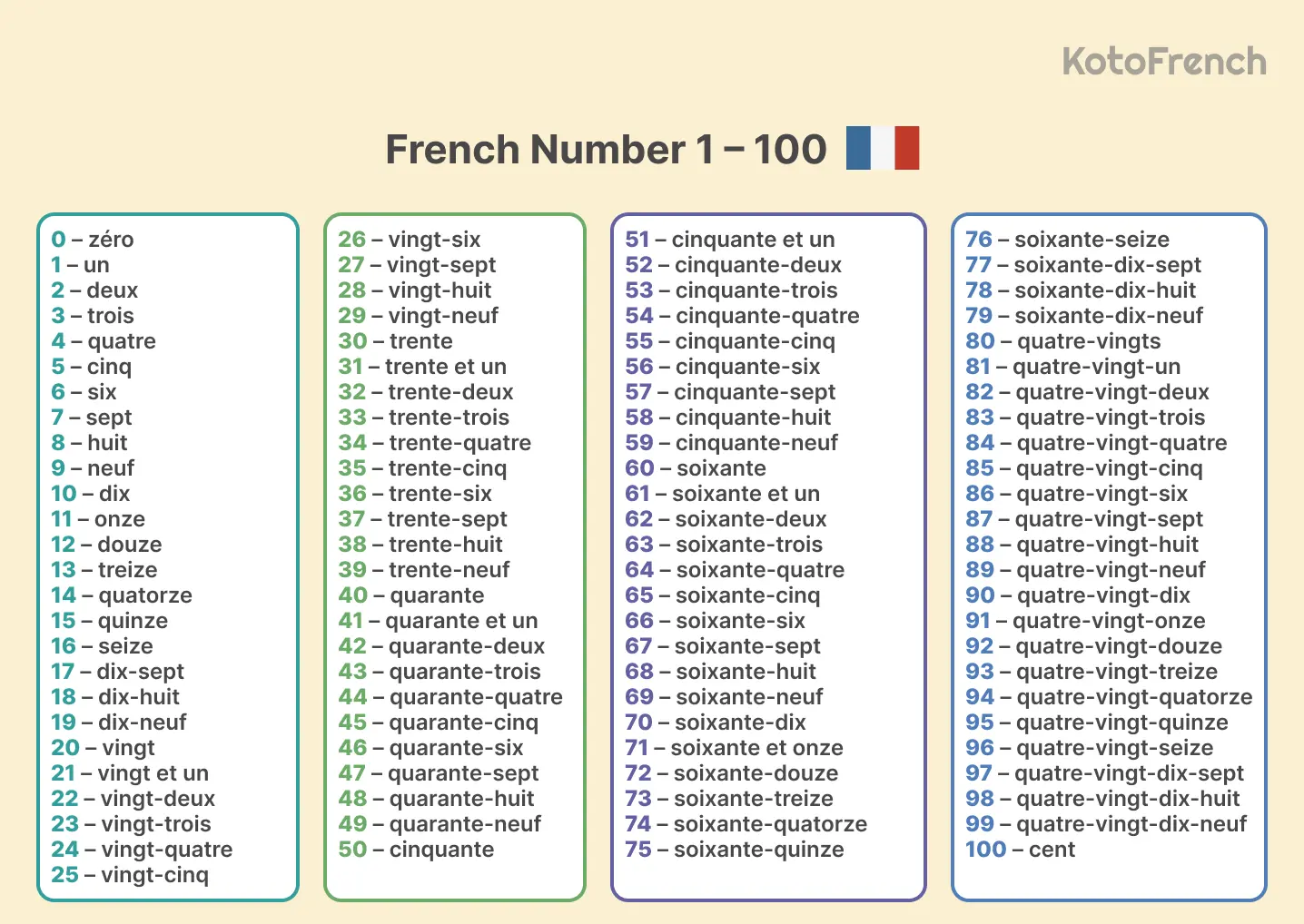
This is a historical attribute developed to simplify pronunciation, and is still used in modern French, but only with specific numbers. Look at the entire list below:
Remember that you don’t need to use et with any other numbers in French (22, 33, 44 and so on). Starting from 81, this rule doesn’t work like that, as the formation is a bit different.
Counting from 100 and beyond
Here comes a new category of large numbers, and you are already partially familiar with it, because this topic is closely related to the previous one. The difference between ones, hundreds, and thousands is that you just need to add a cent to un, deux, and trois. Let’s discuss each in particular.
Hundreds
The major player in this section is the word cent; it is the building block of all numbers in French related to hundreds. Don’t mistake its pronunciation, it is very different from the word cent in English, as it should be said as /sɑ̃/.
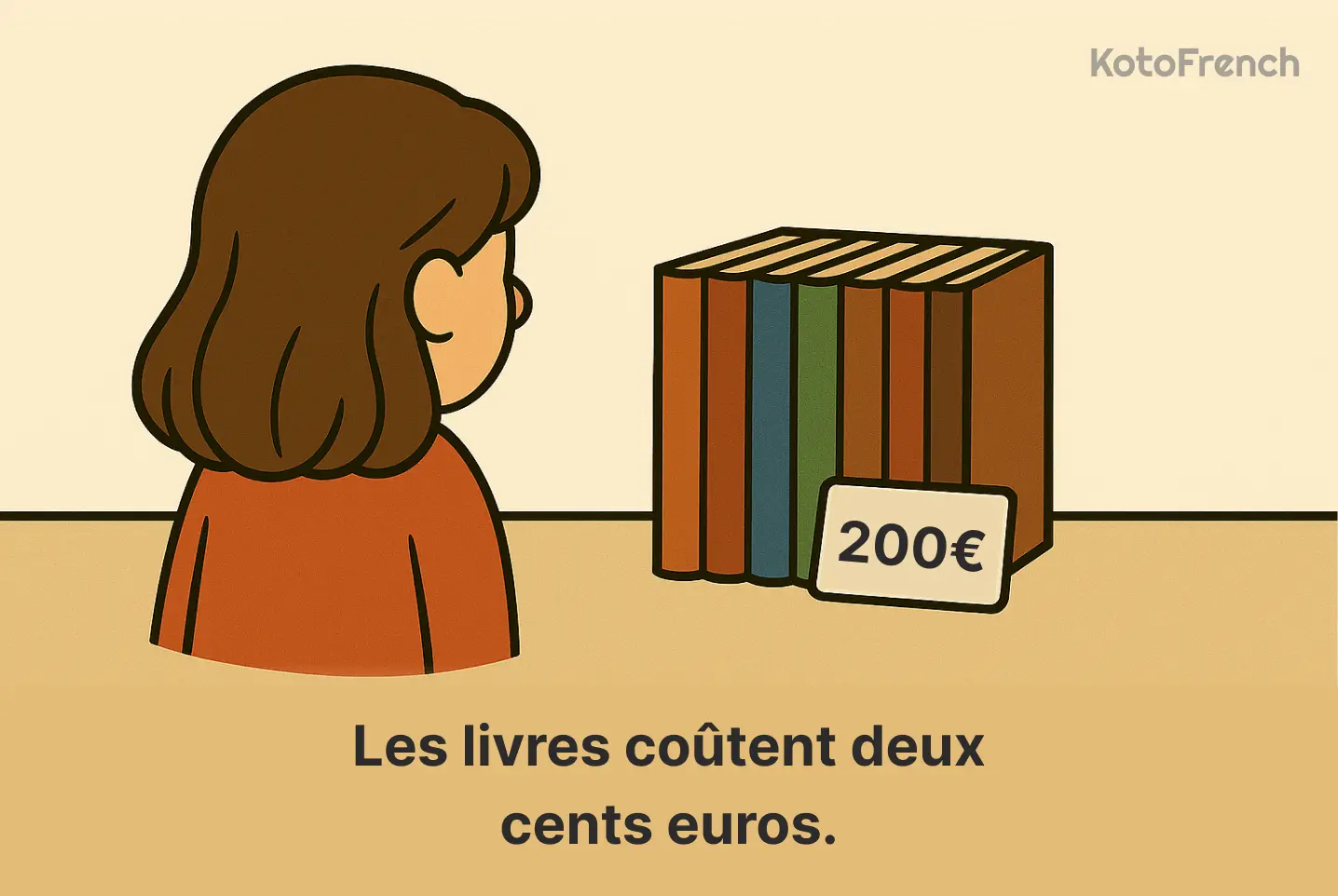
It can be written as cent or cents, depending on the numbers that surround it. For example, if there is nothing after it, like in 200, 300, 400, 500, you add the -s ending:
Does any figure go after a cent? Then, you don’t add -s when another number is added after a cent.
Tip: When un belongs to tens (21, 31, 41), you need to use et, but when it is related to hundreds (101, 201, 301), you don’t use it.
Thousands and millions
Here, the largest numbers come, but the patterns remain pretty simple. Speaking of thousands, the main word you see is mille. Things are easier than with hundreds because mille doesn’t change its form, staying the same no matter what goes before or after it.
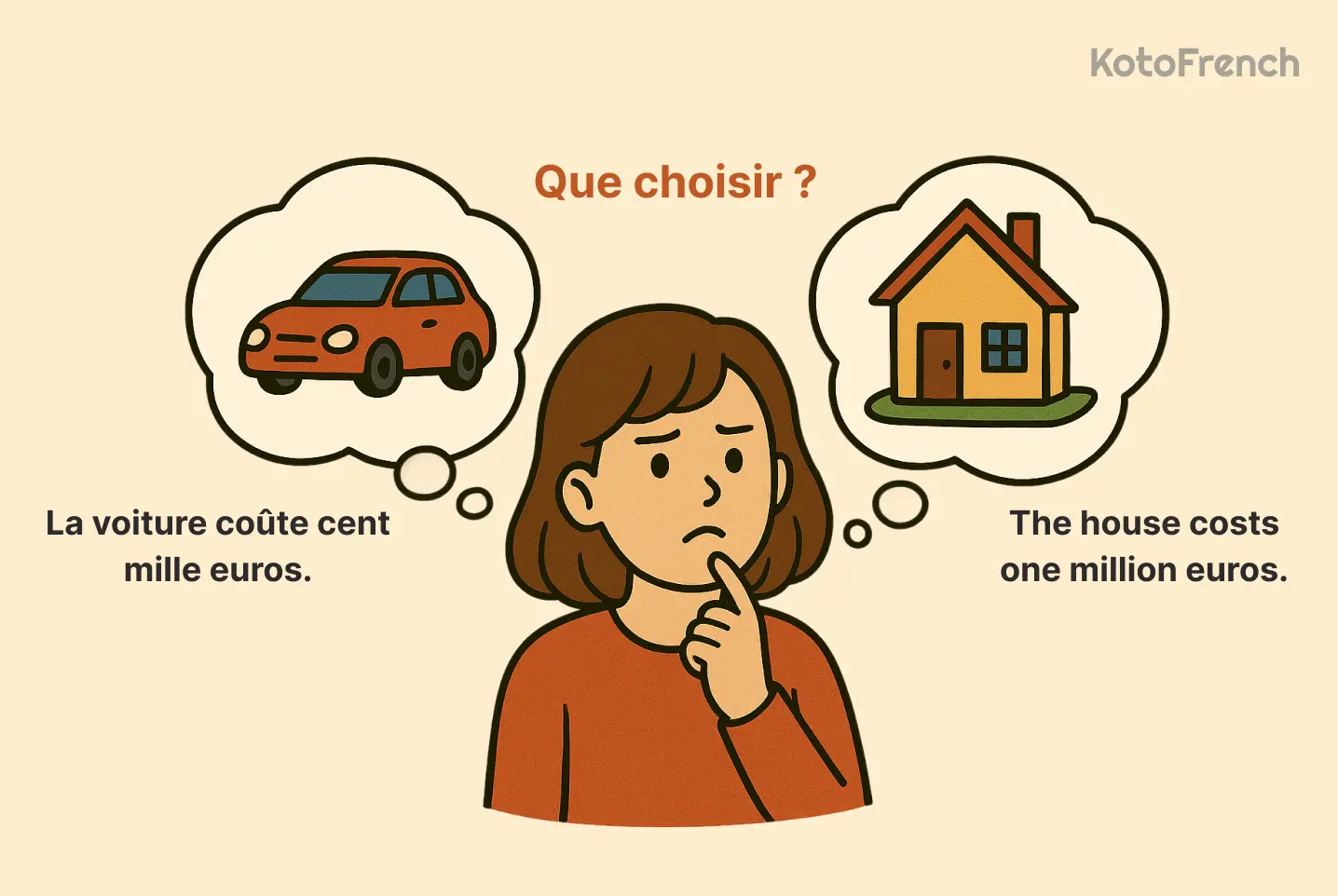
From the examples, you can see that you don’t need to use any articles with mille when counting in French, because it is not a noun. However, when it comes to millions, the situation is completely different.
The French word million is written the same way it is in English. As an ordinary masculine noun, it can have the ending -s when you mention more than one million, is used with articles and is followed by de or d’:
Once you need to pronounce such combinations as shown above, it is important to know how to do it quickly and confidently. Group the numbers to:
- Millions — trois millions
- Thousands — quarante-trois mille
- Hundreds — trois cent
- Tens — quatre-vingt-quatorze
You just name each group of numbers one after another.
Ordinal numbers in French
Les nombres ordinaux (ordinal numbers) allow you to point at the order or position of something. You use them when answering the question lequel ? / laquelle ? that means which one? in English.
By contrast, the cardinal numbers are used for counting and telling the amount or quantity of something, when answering how many? or how much?.
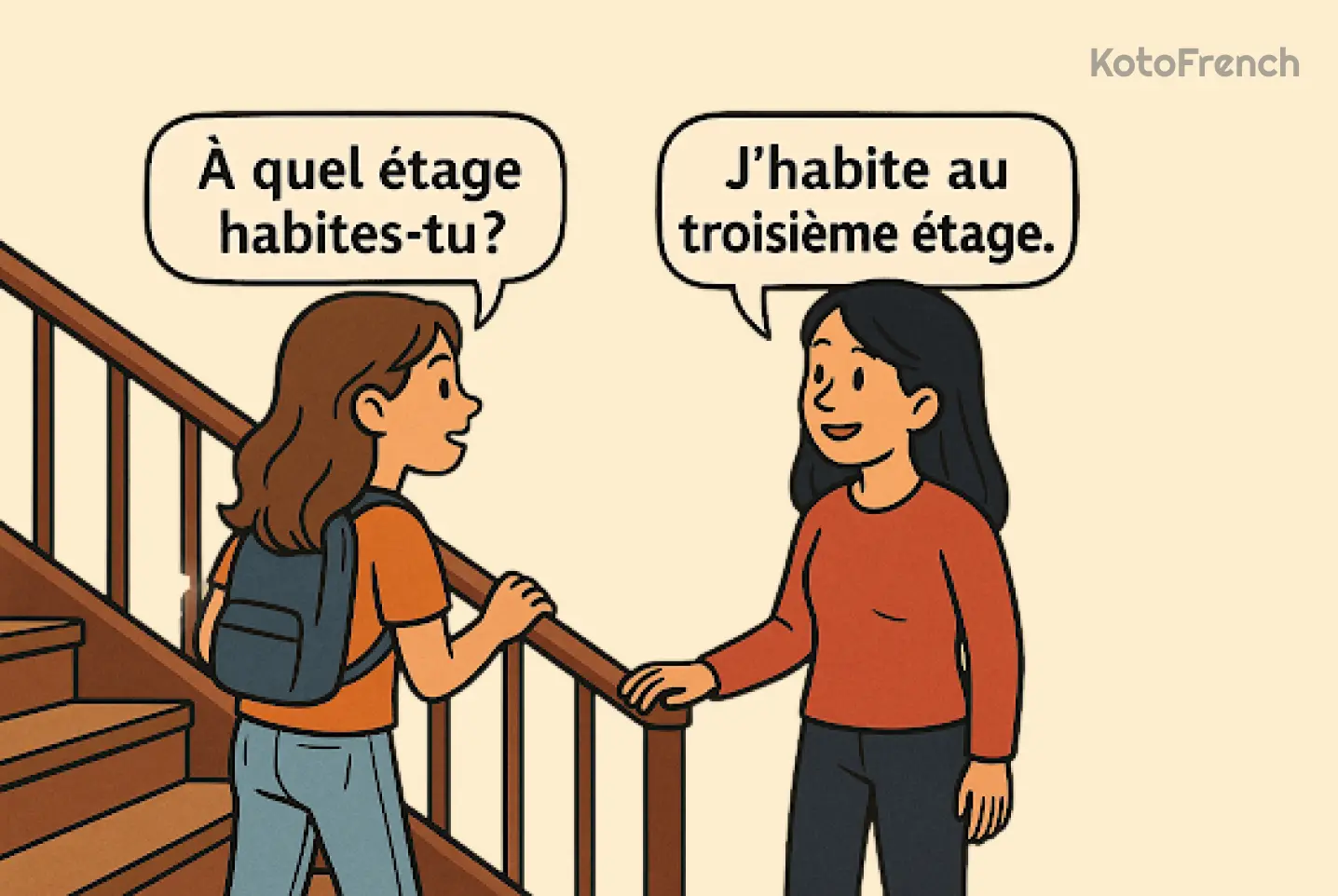
Below are the writing examples of numbers in French with a pronunciation button, from 1 to 21.
|
Digits |
Numbers |
Examples |
|---|---|---|
|
1st |
premier / première
|
J’ai pris le
|
|
2nd |
deuxième / second(e)
|
J’ai pris mon
|
|
3rd |
troisième
|
Elle est dans la
|
|
4th |
quatrième
|
Il a gagné pour la
|
|
5th |
cinquième
|
Elle est arrivée
|
|
6th |
sixième
|
J’ai vu ce film pour la
|
|
7th |
septième
|
C’est la
|
|
8th |
huitième
|
Il est
|
|
9th |
neuvième
|
J’habite au
|
|
10th |
dixième
|
Mon bureau est au
|
|
11th |
onzième
|
Le
|
|
12th |
douzième
|
J’ai fêté mon
|
|
13th |
treizième
|
C’est la
|
|
14th |
quatorzième
|
J’ai terminé mon
|
|
15th |
quinzième
|
C’est mon
|
|
16th |
seizième
|
J’ai obtenu ma
|
|
17th |
dix-septième
|
C’est ma
|
|
18th |
dix-huitième
|
Le
|
|
19th |
dix-neuvième
|
J’ai vu le
|
|
20th |
vingtième
|
Je suis né le
|
|
21st |
vingt-et-unième
|
C’est le
|
You can see that the main rule is to add the ending -ième to almost all numbers in French.


The spelling of some numbers changes, for example, cinq (5) gets an additional -u-, and only then do you add -ième (cinquième). With neuf (9), you need to drop f and add -v instead (neuvième).
Take into account the gender agreement. When writing sentences with masculine nouns, you need to use the article le:
With feminine nouns, you use the article la:
Tip: Premier / première and second (e) are ordinals that are irregular. They have their own forms.
How to use numbers in sentences
Now you know the difference between ordinal and cardinal numbers, and you have also got acquainted with large figures. It is time to learn how you can put this knowledge into practice.
How do you tell dates in French?
The structure is simple: start with the article le, name the day, then the month and finally the year.


Examples:
Tip: Pronounce only the 1st as ordinal. All other days are cardinal.
How do you say your age in French?
The way is similar to the English version, but instead of forms of the to be, you need to use avoir (to have). Look at the formula:


Here are some examples:
|
English |
French |
|---|---|
|
I am 20 years old |
J’ai
|
|
You are 18 years old. |
Tu as
|
|
He is 30 years old |
Il a
|
Examples:
Tip: To produce such sentences naturally, practice conjugating the verb avoir.
How to read prices in French?
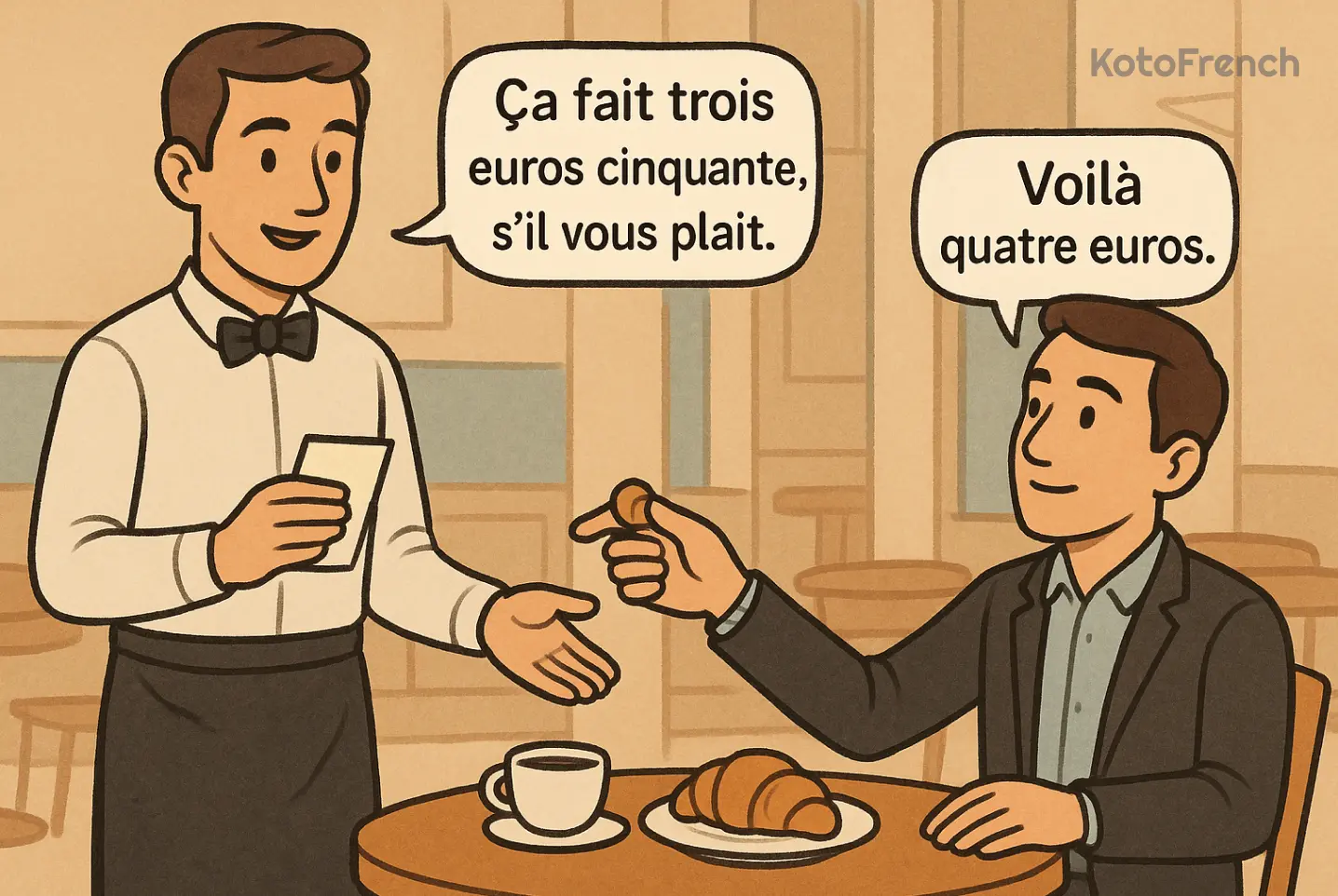
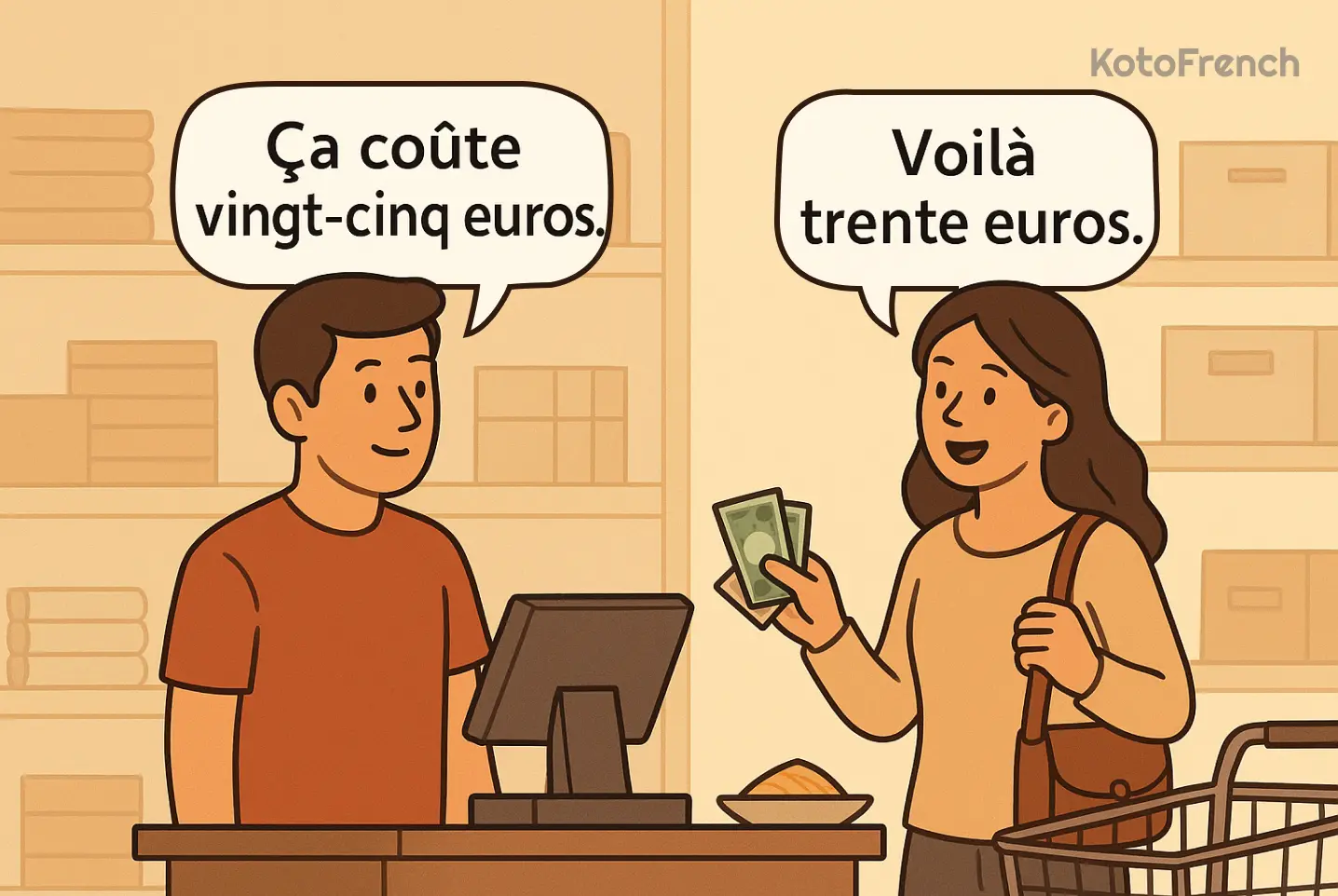
When speaking about prices, you deal with currencies (in France, it is euros) and cents (centimes). So you need to divide the price into two categories and name them as separate numbers, like one euro fifty and two euros twenty-five.


Look at the instances and listen to their pronunciation.
|
Digits |
Read aloud |
|---|---|
|
1 € |
|
|
2,25 € |
|
|
3,99 € |
|
For paying in cafes

For buying tickets
For paying in shops

Tip: In natural speech, French people typically drop centimes.
How to tell time in French?
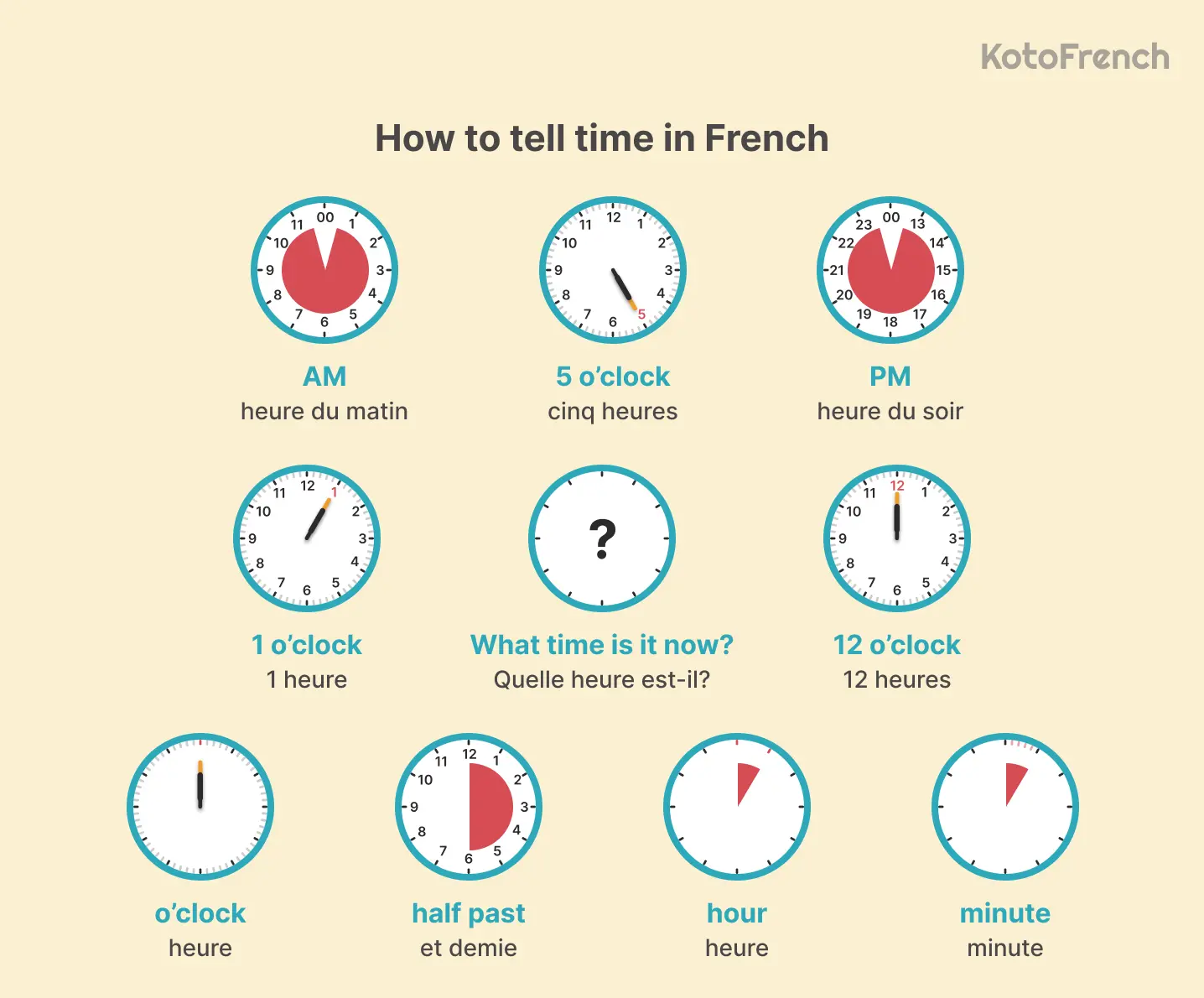
Europe uses the 24-hour clock, especially in formal contexts and schedules, but you will also hear how people from there use the 12-hour clock, so it is important to know both formats to not miss an important meeting or a flight.
The beginning of the structure for both ways is the same, and it sounds similar in English:


Examples:
Here are some more common time expressions:
When mentioning the morning hours, you need to add du matin: Il est huit heures du matin. Speaking of the time in the afternoon, don’t forget about de l’après-midi: Il est trois heures de l’après-midi. In the evening, you need to say du soir: Il est huit heures du soir.
With the 24-hour clock, you don’t need to specify the time of the day, but when it comes to 1:00 p.m., you continue counting with 13, 14, 15, and so on:
|
12-hours format (digits) |
24-hours standard (digits) |
Read aloud |
|---|---|---|
|
1:00 p.m. |
13:00 |
Il est
|
|
2:00 p.m. |
14:00 |
Il est
|
|
6:30 p.m. |
18:30 |
Il est
|
|
9:45 p.m. |
21:45 |
Il est
|
|
11.15 p.m. |
23:15 |
Il est
|
Examples:
Tip: To remember these rules, try to write your own schedule, taking every hour into account and using both patterns.
Enjoy personalized learning!
Exercises
You’ve found out how to count to a million, learned how to apply numbers in practice, and it is time to test how well you’ve grasped the material. Complete a sequence of activities based on the topics we’ve discussed. If you don’t know the answer, try looking it up in our guide.
Learning tips
Mastering every number in French requires a patient approach, and then even a peculiar topic with many exceptions will be an easy task. Just follow this routine:
Tip 1: Practice numbers in groups
In French, numbers have more patterns than in English, and you will learn them faster when you spend enough time on every category, breaking them down into groups like 0-10, 11-16, 17-19, 20-69, 70-99, hundreds and thousands. Compare them and find similarities and differences.
Tip 2: Write numbers in words and digits
Don’t treat them as just digits; memorize the words as well. The easiest way to attach the correct spelling to your memory is to write the list of them, doing it slowly and paying attention to each line.
Tip 3: Apply numbers in real contexts
J’ai huit chansons dans ma playlist. Mon anniversaire est le 9 mai. J’ai visité dix pays. J’ai lu onze romans cette année. J’aurai dix-sept ans bientôt.J’ai sept livres préférés.
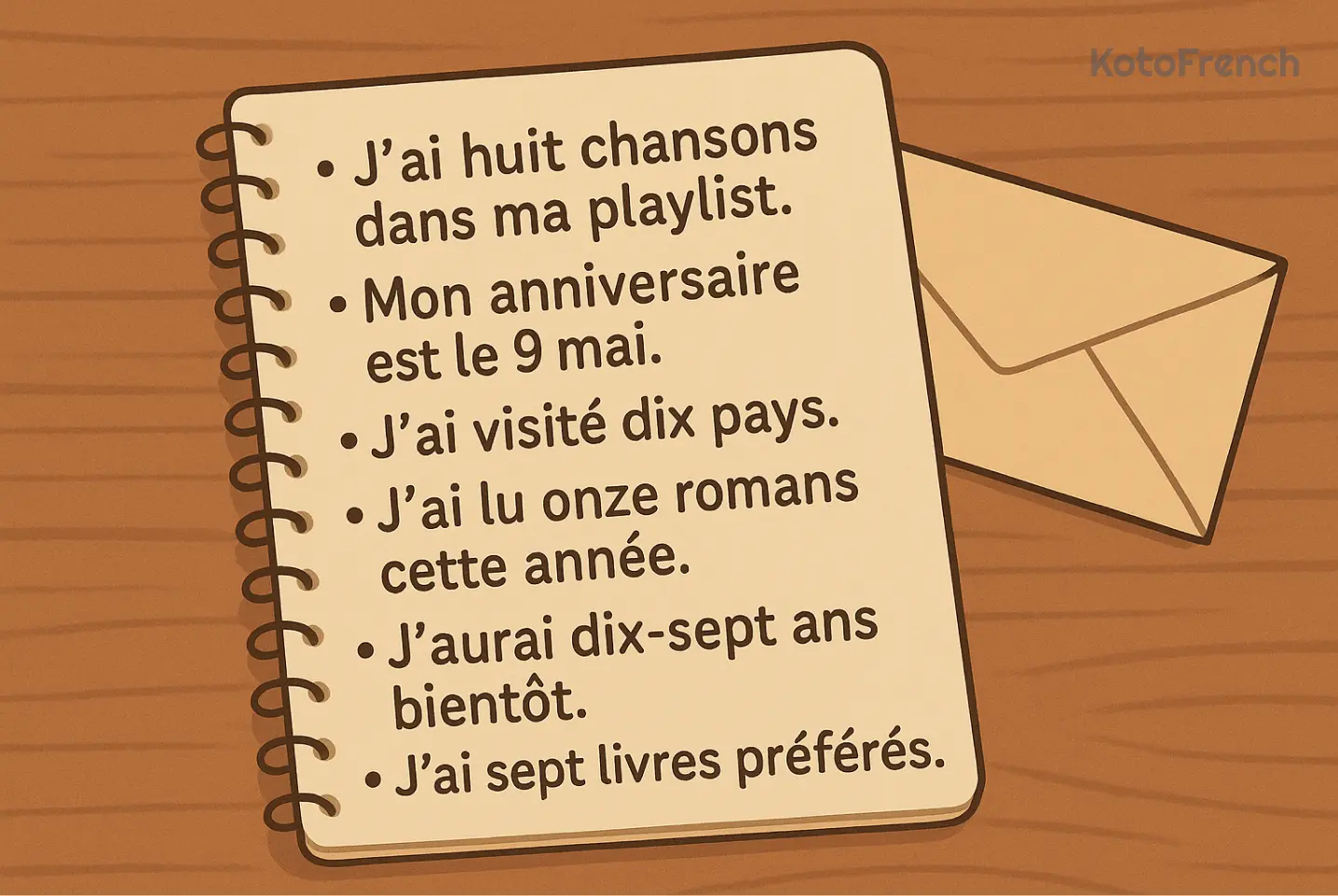
When all French numbers from the core list are backed by some facts from your life, it is easier to retrieve them from your memory, as they become true for you. For example, if your house number is 77, you can write it like my house — soixante-dix-sept.
Start from the very beginning. How many brothers and sisters do you have? How many seasons are there in your favorite TV series? And then move confidently, like Coraline when she needed to count all the items in her new house.
Common mistakes
When it comes to numbers, everything matters, including special signs, words that surround them and the gender. Below, you will find a list of the frequently occurring hiccups that happen with every beginning and sometimes even with advanced learners.
Knowing them will help you avoid them in your speaking and writing.
Number agreement
In French, verbs, nouns and adjectives agree in number. It is correct to pluralize only the noun, as the other parts of speech require the proper forms as well.
| Deux hommes fort. | Deux hommes forts. |
| Trois garçon petit jouent. | Trois garçons petits jouent. |
Tip: For nouns and adjectives, the plural ending is -s; verbs have their own plural forms.
Misusing et in numbers
Et is used in numbers such as 21, 31, 41, 51, 61, 71 to connect two pairs of digits: vingt-et-un, trente-et-un, quarante-et-un and so on.
| Vingt-un élèves sont présents. | Vingt-et-un élèves sont présents. |
| Trente-un étudiants arrivent demain. | Trente-et-un étudiants arrivent demain. |
Tip: The rule doesn’t apply to any other numbers, so you need only to memorize these few.
Forgetting about gender with un
You need to agree the word un with the gender of the nouns. Un is used with masculine nouns, and une is with the feminine ones.
| Un heure est passée. | Une heure est passée. |
| Une garçon joue dans le jardin. | Un garçon joue dans le jardin. |
Tip: Learn some nouns with the numbers to remember. For example, une heure and un jour.
Confusing regional versions
It is correct to say septante (70), huitante (80), and nonante (90) in Belgium or Switzerland, but in France, you need to use the standard versions: soixante-dix (60 + 10), quatre-vingts (4 × 20), quatre-vingt-dix (4 × 20 + 10).
So the incorrect sentences below apply only to France.
| Il y a huitante étudiants dans la classe. | Il y a quatre-vingts étudiants dans la classe. |
| La page nonante contient les résultats. | La page quatre-vingt-dix contient les résultats. |
Tip: Both can be correct, but you need to use the correct version in the country you are in.
Summary
Having learned the patterns of number formation, their differences and common mistakes, you will have the necessary base needed to use them correctly. Furthermore, work on your French numbers pronunciation, as it is quite tricky and requires regular practice.
Train numbers by writing dates, numbers, birthdays, time, and addresses, and soon they will sound natural and authentic in your speech.
FAQ about counting in French
Numbers in French, or les nombres français, are words that match the digits, such as 1, 2, 3, and so on. They are used to show the order of things, talk about the quantity of something, ages, time, dates, and prices. They can be cardinal ( un , deux , trois ) and ordinal ( premier , deuxième , troisième ).
The basic rule of forming ordinal numbers requires you to take the cardinal number and add the ending -ième. Look at some examples:
Both cent and cents are related to hundreds; however, they differ in usage. You use cents with 200, 300, 400, and so on, where there are no numbers after it:
When speaking about a singular 100 or a number followed by another (110, 120, 450), use cent.
This tradition comes from Old French, when people didn’t count in tens and the basic number was 20. So, the French eighty is literally four twenties (quatre-vingts). You need to add -s to the word vingt when it stands alone (80), but drop it when another number follows:
When it comes to pronunciation, there is a French numbers list that is considered a tongue twister: the range from 70 to 99. The difficulty lies in the compound formation method: instead of giving these numbers unique names, French people use math. So, when saying them, you need to not only think about the tricky pronunciation rules but also count.