


What are French adjectives?
French adjectives are words that define or qualify nouns with further specifications of people, objects, places or concepts. They might refer to such things as color, size, shape, feeling or other characteristics.
The adjective words in French are likewise dependent on the number (plural or singular) and gender (masculine or feminine) of the word to which they are applied, contrasting with the English adjectives. Such an agreement is necessary to ensure that the sentence is grammatically correct.
Grand, which means towering or big, changes depending on the noun. Here’s an example:
French adjectives can have a position of preceding or following the noun, as per the meaning and style. The majority of the adjective descriptive phrases tend to be placed after the noun:
There are some common prenominal adjectives, especially those dealing with size, amount or attractiveness:
There are also adjectives in French that are more intensive with the help of adverbs, such as tres (very) or assez (quite):
To get clear and expressive sentences, it is necessary to have a basic idea of the purpose of the adjectives. In French, sentences become clearer and more natural when you know how adjectives vary by gender and number and their correct placement.
Level up your English with Koto!
Types of Adjectives
French grammar groups adjectives into distinct classes, and each of them builds meaning differently. All categories play a special role in forming the meaning. Descriptive, possessive, demonstrative, interrogative, and indefinite adjectives are the most significant ones to be learned.
Descriptive adjectives
Adjectives that are descriptive give qualities or characteristics to a noun. They are able to talk of color, shape, personality or anything that further details. Such are the most habitually encountered adjectives learners would come across initially.
Adjective descriptions normally come at the end of the noun, although some are used at the beginning of the sentence, particularly those of size, beauty, or age.
Possessive adjectives
Possessive adjectives reveal ownership or belonging. Their agreement is with the noun they modify, not with the owner.
You can see that mon, ma, and mes all mean the same thing as my, however, the pattern varies based on the noun.
Demonstrative adjectives
Demonstrative adjectives mark the specific nouns. They are different in French by gender and number.
They are useful for distinguishing one thing/person from another.
Interrogative adjectives
Questions about nouns refer to the interrogative adjective. They assist in the specification of what item or person is being referred to.
Remember that these adjectives always agree with the gender and number of the noun.
Indefinite adjectives
Indefinite adjectives are nouns of a nonspecific kind. They provide a broad indication in the form of quantity or identity without having to indicate a particular item.
They are used in presenting generalizations or imprecise references in the sentences.
In French, adjectives are used in diverse ways, either to give more information about a noun, to indicate property, to name objects, to pose a question or to indicate unnamed things. Descriptive, possessive, demonstrative, interrogative and indefinite adjectives are skills that help you become more accurate and flexible in your French.
Rules for using adjectives in French
Adjectives have to correspond to the gender and number of the noun they refer to, i.e., masculine or feminine; singular or plural. Such rules should be obeyed in designing grammatically correct phrases, besides making descriptions that would have a smooth flow.
- Gender agreement (masculine/feminine)
Nouns in the French language are either male or female, and the adjectives that accompany them cannot be of a different gender. The majority of adjectives are constructed on the masculine and feminine forms, which are generally formed by the addition of -e at the end. Review the French adjectives list we gathered for you:
We want to warn you that some adjectives have irregular feminine forms:
The adjectives that have the ending -eux tend to modify to -euse in the feminine:
- Number agreement (singular/plural)
There is also variation in the use of adjectives when the noun is singular or plural. In the vast majority of adjectives, changing to the plural form is very simple: adding an -s:
Usually, a list of French adjectives with a final -x, -s does not change to plural:
A feminine noun can be plural, in which case the feminine -e will endure the plural -s:
- Placement notes
Although certain typical adjectives, like those describing size, beauty, or quantity of something, come before the noun, the adjectives are typically put after the noun:
In order to deal with French adjectives with ease, pay attention to gender and number agreement.
Masculine and feminine forms, as well as singular and plural endings, give your sentences balance and accuracy. With practice, these details slip into place naturally, allowing expression to feel fluent and precise.
Common irregular adjectives
Most French adjectives have regular rules of gender and number agreement, but some of them are irregular and must be paid particular attention. The non-regular adjectives tend to alter their endings non-standardly.
Beau/belle, nouveau/nouvelle, vieux/vieille, and the adjectives whose plural form is not regular (ended in al, aux, etc.) belong to the most frequent.
- Beau/belle
The adjective beau (beautiful, handsome) varies in form according to both the gender of the word and the number of the noun it is applied to, and therefore it is important to ensure that the adjective is used in the correct form concerning the subject matter.
In the presence of the beau of a masculine noun that begins with a vowel or silent h, it becomes bel:
- Nouveau / nouvelle
The adjective nouvelle (new) also possesses irregular forms and also has a pattern like beau, which varies according to the gender and the number of the noun to which it is applied.
Moreover, it assumes a particular form, nouvel, before nouns of the masculine gender starting with a vowel or a silent h so that the sentence is smooth-running and sounds natural. It is worth noting these differences to get the adjective right in both verbal and written language.
In front of the masculine nouns, whose beginning is a vowel or mute h, nouveau is changed to nouvel:
- Vieux / vieille
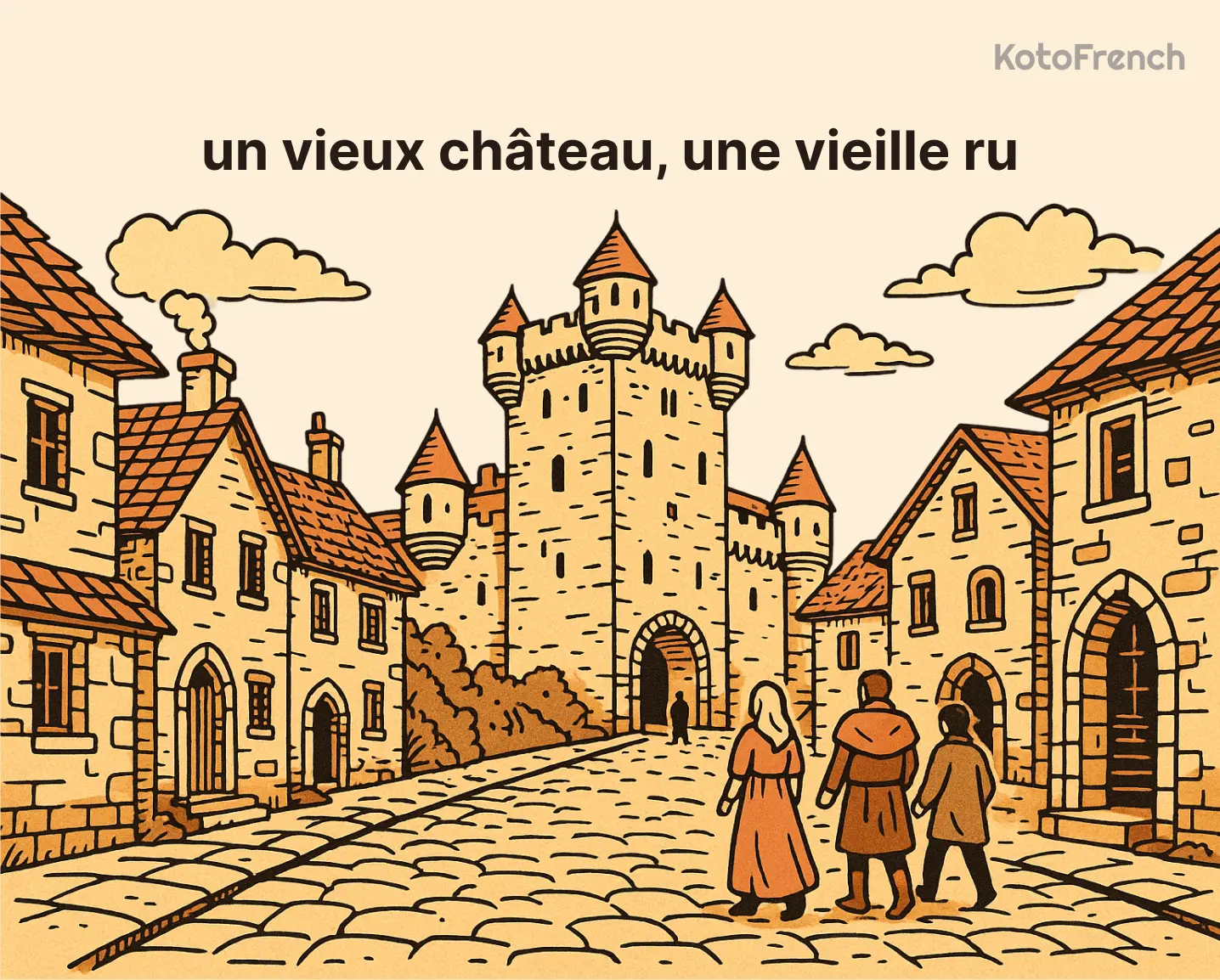
Vieux (old) becomes vieille in feminine plural and vieil in masculine plural, which have a vowel or a mute h at the beginning.
- Plural forms: -al → -aux
There are also French adjectives which have a termination -al and the plural is irregular -aux, instead of the normal -s.
These irregularities are not exceptions to study individually, but patterns to be identified. After familiarity, they are intuitive.
We have compiled a table for you with different forms of irregular adjectives for better memorization:
| Adjective | Masculine singular | Feminine singular | Masculine plural | Feminine plural |
|---|---|---|---|---|
|
|
|
|
|
|
|
|
|
|
|
|
|
|
|
|
|
|
|
|
|
|
|
|
|
|
|
|
|
|
|
|
|
|
|
|
|
|
|
|
|
|
|
|
|
|
|
|
|
|
|
|
|
|
|
|
|
|
|
|
Working with a wide range of adjectives will improve your ability to describe people, objects and ideas clearly, helping your sentences flow organically.
Position of the French adjective in a sentence
The arrangement of an adjective does not necessarily match what is found in the English language. As we have already mentioned, contrary to the English language, where adjectives nearly always come before the noun, the French adjectives may come before or after the noun, and their placement can even modify the meaning of the sentence.
Adjectives that usually follow the noun
Again, earlier in the text, we noted how to use adjectives in French and that descriptive adjectives are mostly placed behind the noun. These adjectives are not necessarily subjective in describing qualities, characteristics or details.
The default option of most adjectives is to place the adjective after the noun, and this stresses the description.
Adjectives that usually come before the noun
In French adjective order, other adjectives, especially those of beauty, age, goodness, and size (commonly remembered by the mnemonic BAGS), come before the noun.
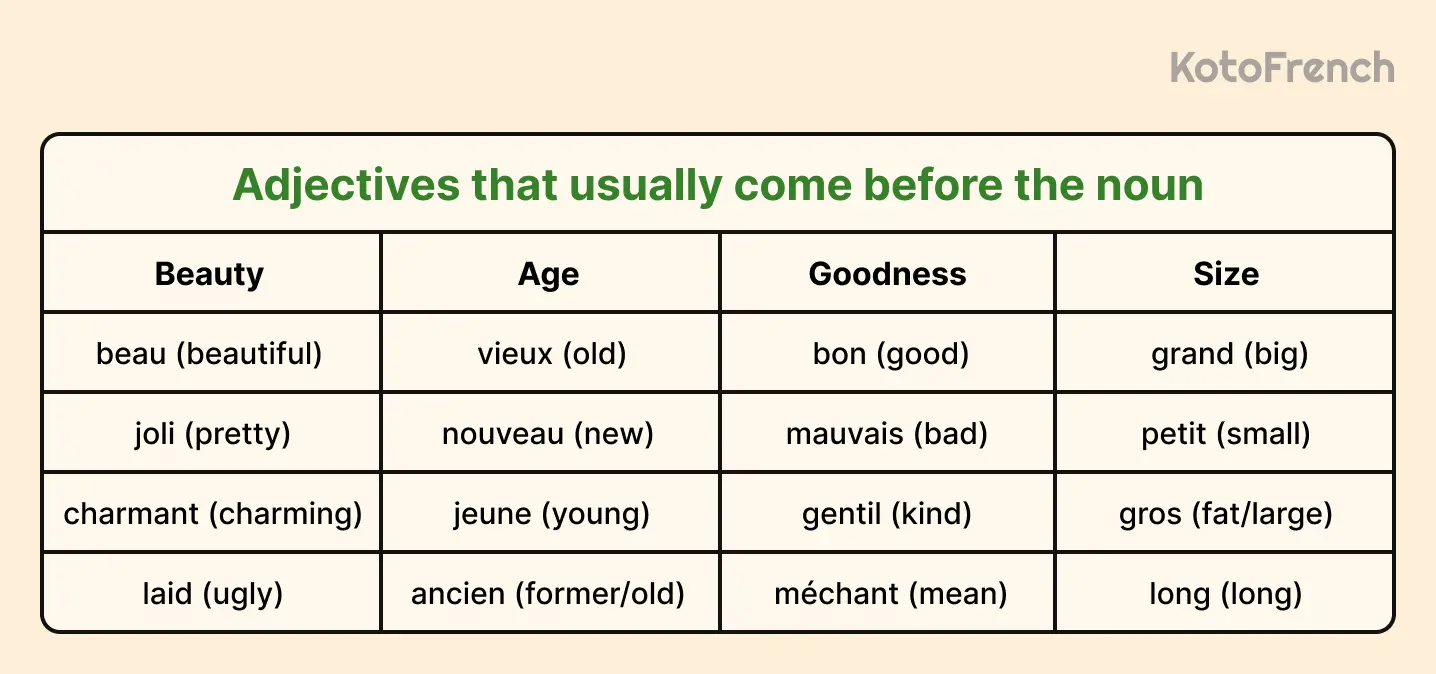
All these adjectives can render a more subjective or emotional judgment as opposed to a mere description.
Adjectives that change meaning based on position
Some adjectives are used in various meanings when they come after the noun or before. In order to convey the desired feeling, it is critical to attend to this difference. Look at this adjectives in French list:
More examples of adjectives that take on different meanings depending on their placement are provided in the table below.
|
Adjective |
Before the noun |
After the noun |
Example (before) |
Example (after) |
|---|---|---|---|---|
|
cher |
dear/beloved |
expensive |
Ma
|
Un bijou
|
|
pauvre |
unfortunate/poor (figurative) |
financially poor |
Le
|
Un garçon
|
|
dernier |
final |
last (in a series) |
La
|
Le mois
|
|
sale |
nasty/wicked (figurative) |
dirty |
Un
|
Les mains sont
|
It becomes automatic to identify adjectives that change meaning and to identify where to place them in the right place with repetition.
Typical learner mistakes
The proper way to avoid mistakes is to be aware of them, especially those that are typical for most students. In this chapter, you’ll find errors that often appear in speaking, reading, and writing and that can affect your fluency when using French adjectives.
Forgetting agreement
One of the most important errors that learners make is forgetting to make adjustments to endings.
|
un vieux bâtiment ancienne
|
un vieux bâtiment ancien
|
|
des voitures rapide
|
des voitures rapides
|
Misplacing adjectives
Some adjectives change in meaning when preceding or following the noun, as we not once explained above.
|
un peintre célèbre
|
un célèbre peintre
|
|
une maison pauvre
|
une pauvre maison
|
Confusing irregular forms
Adjectives, including beau, nouveau and vieux, are usually error-prone, especially when the adjective is positioned at the beginning of the sentence, ahead of nouns beginning with a vowel or a silent h.
|
un beau arbre
|
un bel arbre
|
|
un long rue
|
une longue rue
|
Overusing default adjectives
Excessive use of the most frequent adjectives (grand, bon, joli) may cause repetition of speech. Substituting learning styles and description words increases the clarity and style.
|
une grande maison, un grand homme, un grand livre
|
une vaste maison, un homme influent, un livre captivant
|
|
un bon film, une bonne journée, des bons souvenirs
|
un film passionnant, une journée mémorable, des souvenirs précieux
|
Being able to identify these recurrent mistakes will make your French more correct and more fluent. Even advanced learners slip up, so focus on practice, reading, and self-correction to develop confidence and accuracy in using adjectives.
Enjoy personalized learning!
Practice time: mastering French adjectives
Workouts that improve your comprehension of agreement, placement, and meaning shifts are the most effective method to build confidence while using French adjectives. Here are some context-based exercises with common adjectives in French to assess your abilities.
Tips to learn and practice French adjectives
French adjectives are best acquired through drills. In addition to memorizing, active training and repetition will reinforce knowledge of forms, agreement, sentence position, and slight changes in meaning.
- Flashcards for forms and gender
Flashcards make French adjective practice look like a visual game. On one side is the masculine singular, on the other side, the feminine, masculine plural and feminine plural. Provide some real-world instances to illustrate agreement in context, such as these adjectives in French examples: un ciel bleu → une mer bleue or un repas délicieux → une tarte délicieuse.
- Speaking exercises
Agreement and placement of French adjective rules can be internalized by saying adjectives aloud. Talk about rooms, or people, or things: une robe elegante, un sac lourd, des fleurs magnifiques. Be careful of those adjectives whose meaning varies with the place, e.g., un grand artiste, un artiste grand. Sentences naturally flow when spoken regularly.
- Writing short descriptions
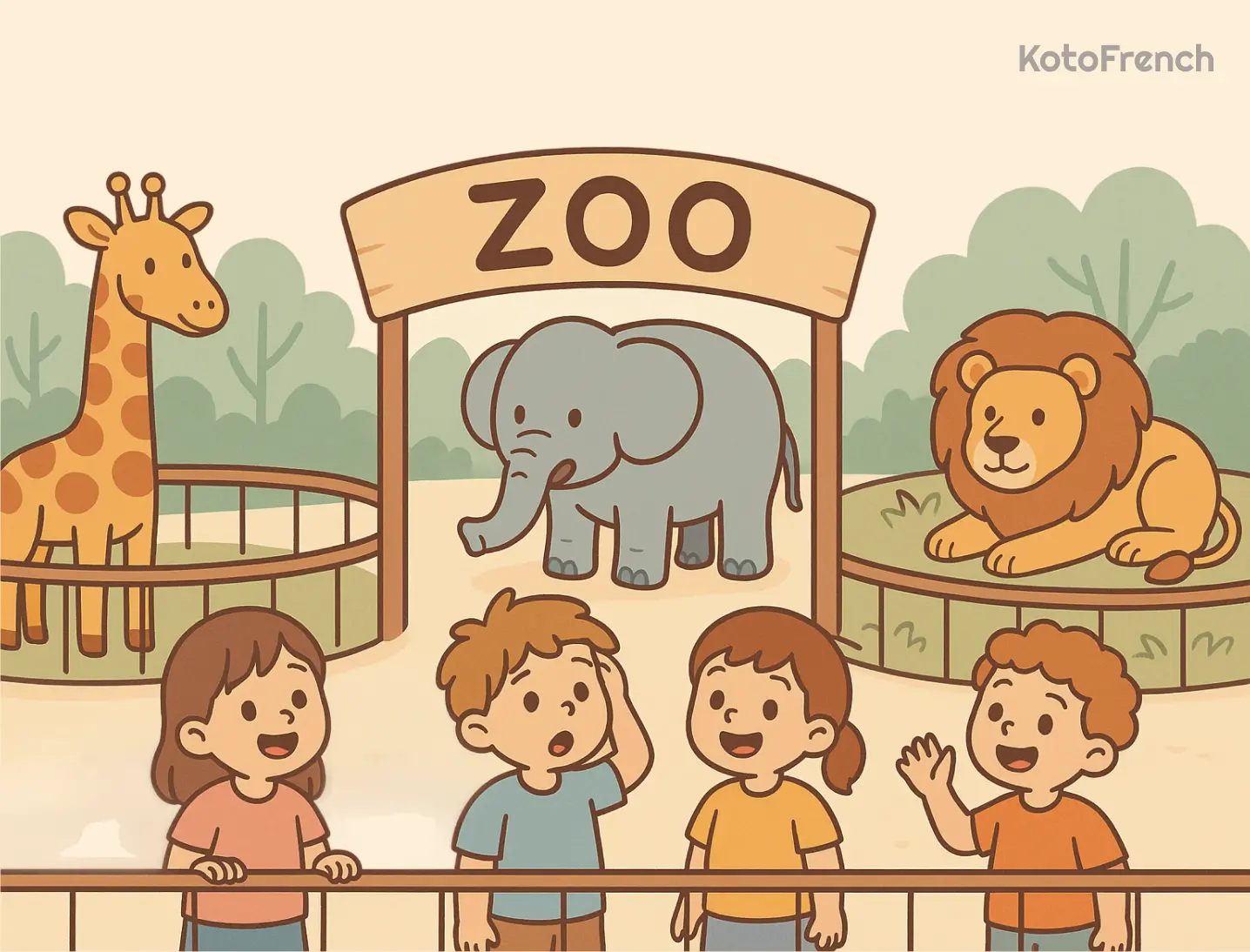
Writing the adjectives makes your command more solid. Attempt to give daily experiences, books of choice, or last trip: J’ai passé la journée dans un village pittoresque avec des maisons colorées et des rues calmes.
Pay attention to proper masculine/feminine and plural/singular forms and practice positioning adjectives before or after the noun, and how the positioning of adjectives influences meaning.
- Combine techniques
You will learn best through a combination of methods. Attempt to form a short description using the French adjective list in your flashcards, and read it aloud and correct mistakes. The forms and agreements should be made second nature through reading, speaking, writing and listening.
- Activities in real-life contexts
Use adjectives in real-life situations to reinforce learning. We advise talking about photos, things in a shop, or people you meet. Even thinking or speaking to yourself in French while doing daily tasks counts. Words are easier to remember when used more frequently.
The regular use of such tactics will give you confidence when it comes to using French adjectives. Your sentences will be more precise, descriptive and grammatically correct, and one day, you can identify agreement, placement and subtle meanings naturally.
Conclusion
Adjectives can influence our perception of the world and in French, they add richness and flavor to each sentence. These patterns will be fixed with practice in reading, speaking and listening.
As time goes by, adjectives cease to be a rule that you have to bear in mind, but become something that you train unconsciously. One step at a time, your sentences will be simpler, smoother and even closer to native expression.
FAQ about common French adjectives
Adjectives must agree with the gender (masculine or feminine) and number (singular or plural) of the noun they describe. For example: un chat noir (a black cat, masc. sing.), une robe noire (a black dress, fem. sing.), des chats noirs (black cats, masc. plural).
Useful starter list of adjectives in French includes:
You’ll stumble upon these again and again in daily conversations and readings.
To avoid translations that are not natural, the learners should embrace the following measures:
- Learn phrases in the block. Learn whole phrases in French, rather than translate word-for-word
- Note adjective position. When using French adjectives, the arrangement is not usually the same as in English.
- Read and listen to French. Natural reading and listening of the French language helps to internalize the correct structures.
- Begin to speak and write French. Before you talk or write, challenge yourself to see how a native would say it.
- Be careful of pitfalls. Calques often occur with such words as actuellement (actually) or demander (demand).
Flashcards, repetition, and grouping adjectives by patterns help a lot. To illustrate, several adjectives that have the –eux as their endings change to –euse in the feminine. Naturally, when you write short descriptions about people or objects in your day-to-day life, it also strengthens inflections.
Shifting the pose distorts the feeling. Un homme grand refers to a tall man, though un grand homme changes to a great man. In the same manner, une maison ancienne means an old house, and une ancienne maison means a former house.