

What is an article in French?
An article in French is a special term that speakers use with nouns to indicate the gender and number of people or items. In texts or speech, articles, depending on their type, also play a crucial role in referring to non-specific or specific nouns, just as in English.
Why do you need to learn them, actually? Because articles in the French language make your idea clear in a sentence. Let’s model a simple situation: you need to borrow a specific book from another student. You say:
Le here allows your classmate to identify which concrete book you need, not a random one from their bag. It makes your request obvious from only one sentence.
Level up your English with Koto!
Definite articles in French
Le, la, l’, les mean “the,” a common article you use daily when speaking English. The trick is that a definite article in French is presented in four words, and you need to put them according to the noun’s gender, number, and specificity.
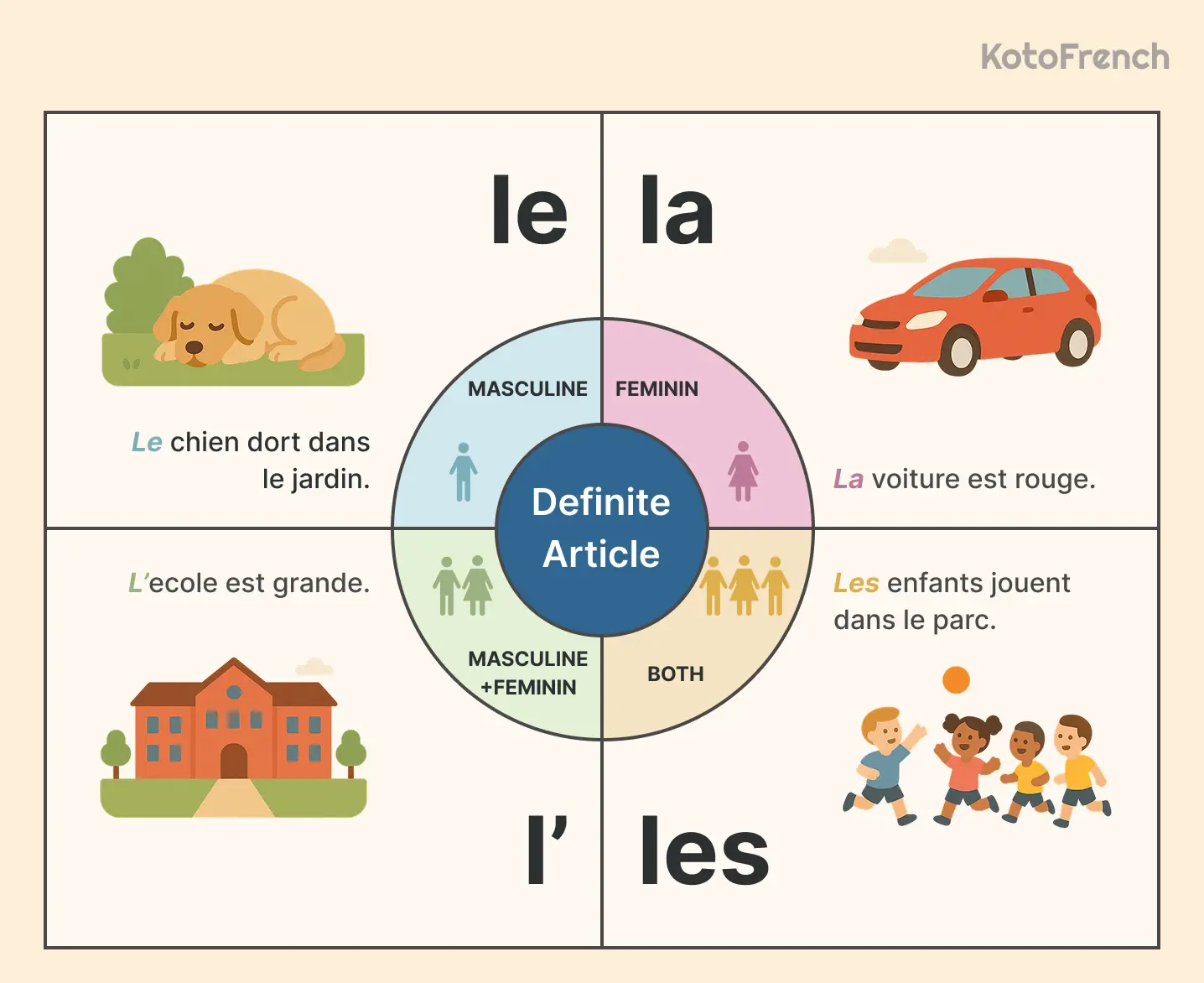
In the table below, you can learn how and where to use each of them, with real-world examples:
| Article | Gender | Count | Example |
|---|---|---|---|
| le | Masculine | Singular |
|
| la | Feminine | Singular |
|
| l’ | Masculine + feminine | All singular nouns that start with a vowel or silent h |
|
| les | Both | Plural |
|
Answering the question, “What are articles in French?” you noticed that we talked about specific nouns that are used with the article “the.” Here are some examples with translations that will help you to understand it better:
The standpoint here is that you need to differentiate between English and French, because articles in this language are used in some unexpected situations:
You can also use the terms in various contexts: something or someone you like, languages you speak, learn, names for countries, and more.
Indefinite articles in French
If you need to write or say about something or someone non-specified, you need an indefinite type of terms: un, une, des, which stand for a/an/one/some in English.
These terms can be put in a sentence only with countable nouns (or noun phrases), so you may find this rule simpler. It is also possible to put un, une, or des for some abstract nouns, like an idea, idée, and problème.
| Article | Gender | Count | Example |
|---|---|---|---|
| un | Masculine | Singular |
|
| une | Feminine | Singular |
J’ai acheté
|
| des | Both | Plural |
J’ai
|
We noted that “some” in English can be the reference for the indefinite article in French, but you don’t need to translate. It is more like written between the lines in context, and you can understand it through the context:
The part “some” is not necessary here because you can realize it naturally, but it is still important for grammar understanding.
Partitive French articles
Considering French articles grammar, which is widely used by speakers who talk about uncountable nouns or things that can not be counted. There are four of them: du, de la, de l’, des.
Referring to English, these terms are quite similar to “a little bit,” “some,” or “a portion of.” Here is a simple table that will help you understand the usage with real examples.
| Article | Gender | Count | Example |
|---|---|---|---|
| du | Masculine | Singular |
Je veux
|
| de la | Feminine | Singular |
Elle boit
|
| de l’ | Masculine | Singular |
Je bois
|
| des | Both | Plural |
Je mange
|
As uncountable nouns are common in the French language, you will use them a lot, though it is not common in English, which can confuse learners. Talking about drinks, meals, and professions — there are numerous topics where you will use a French article. Let’s review more examples:
Mastering this grammar point, you will be able to speak and write messages about something uncountable (which are also the same in English): milk, tea, coffee, etc.
Articles with countries and places
Depending on the gender, singular and plural points, you will use le, la, l’ or les with locations. Let’s consider every rule you need to learn to use articles in the French language correctly.
- Countries. In this case, you need to put definite articles in French, which you already know. Here, you are able to check some examples and descriptions of the core rules:
| Article | Gender | Examples |
|---|---|---|
| le | Masculine |
|
| la | Feminine |
Que pensez-vous de
|
| l’ (first vowel letter or silent h) | – |
Je trouve que
|
| les (plural) | – |
Mon ami souhaite visiter
|
- Cities. You don’t need an article with cities and islands, which is a good point. You only put a preposition a, which we will consider in another article. Check out some examples:
-
Places. Here, you need to use the same le, la, l’ and les with à, which is an essential part and can not be missed. There is an exception in French article rules for le and les:
à + le form au
à + les form aux
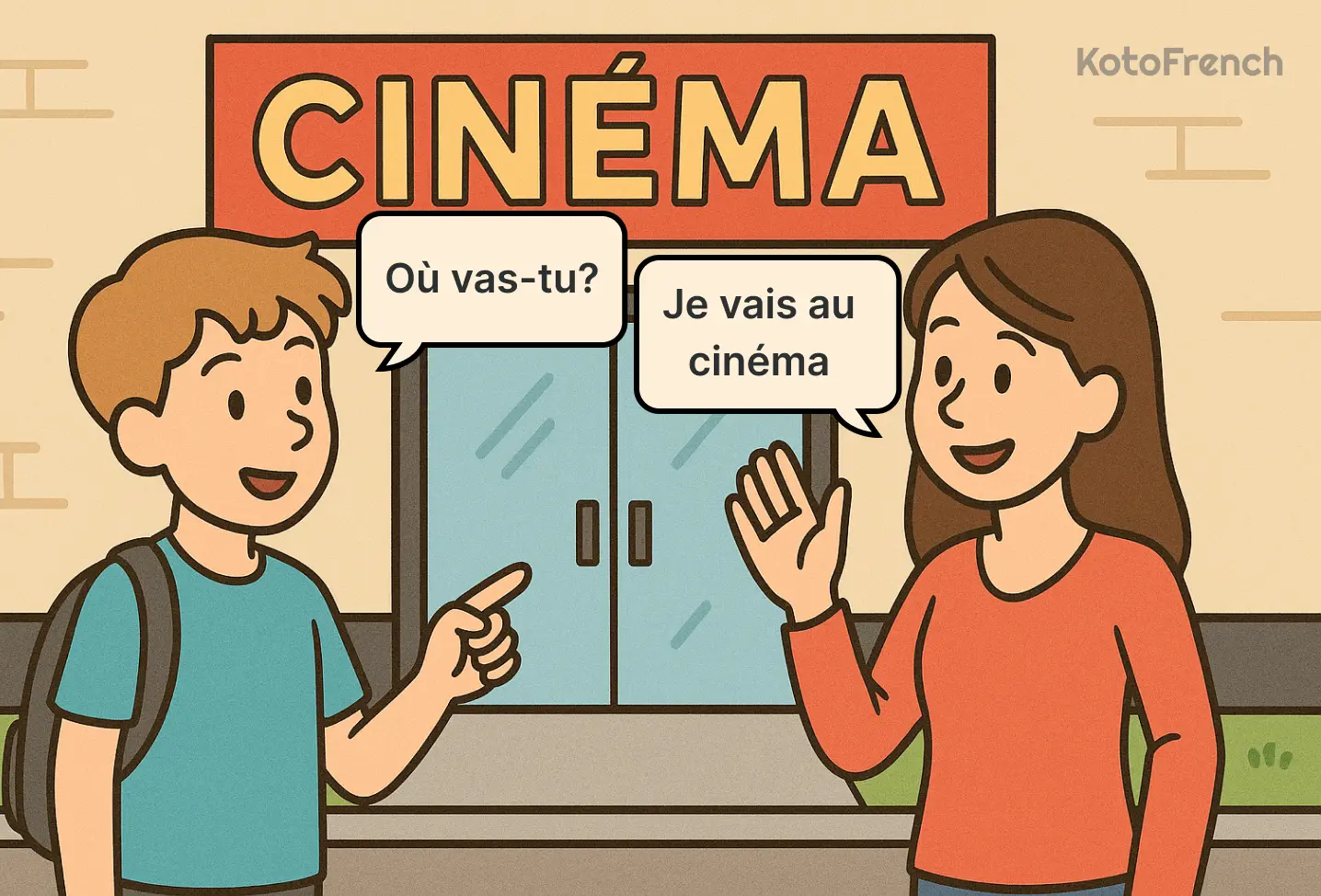

- Où vas-tu ? — Where are you going?
- Où vas-tu ? — Where are you going?
- Où vas-tu ? — Where are you going?
- Où vas-tu ? — Where are you going?
The best way to learn this not easy concept is to practice a lot using fun and engaging exercises for this mandatory grammar. Further, you will learn about uncommon situations that follow no grammar rules and need to be learned by heart.
Special cases and exceptions
New learners have to remember exceptions to become fluent in French and speak/write without mistakes. Your accuracy defines whether native speakers understand you and whether you will reach a high score on your test. Let’s go over to the point of every special case you meet in learning articles in French grammar.
— No articles for professions and nationalities
but if you add an adjective, you put an article:
— No articles for mon/ton/son (my, your, his/her)
— No articles for demonstrative adjectives (ce, cette, ces)
Learning these concepts of French articles list nuances will make your communication richer and help you to prepare yourself for more complex grammar in the future.
Common mistakes to avoid
The one who makes no mistakes is the one who does nothing. Still, it is better to be aware of any errors possible to avoid them in the future when you text your French penpal in WhatsApp or talk live when traveling.
Confusing gender
The main category of students who make this mistake is English speakers who are not used to gender for nouns and French article rules. Here are some examples:
|
J’ai bu la café ce matin.
|
J’ai bu le café ce matin.
|
|
La frère est gentil.
|
Le frère est gentil.
|
Misusing quantified and unquantified articles
It is common to confuse general and specific articles, and here, you need to pay attention to the context. It means that you define if the speaker (or you) means, let’s say, sport like an unspecified term, or some particular one.
|
J’ai acheté un bière.
|
J’ai acheté de la bière.
|
|
Je bois un eau après le sport.
|
Je bois de l’eau après le sport.
|
Ignoring the silent h sound in nouns
We mentioned this rule a few times above. A “silent h” means that you don’t pronounce it in a noun. Here, you need to use l’, which is used for a more natural and smooth sound.
|
J’aime la histoire à l’école.
|
J’aime l’histoire à l’école.
|
|
Je me réveille à la heure tous les matins.
|
Je me réveille à l’heure tous les matins.
|
You have learned about all possible concepts about articles, so further, you are able to take a French article practice and master your understanding of this grammar.
Enjoy personalized learning!
Practice exercises
What are articles in French? How to be sure you know their usages? You can check your knowledge with our engaging activities, which also have answers. Check your topic understanding and improve your French in real time.
Practical tips for learners
French article practice is a perfect way to become fluent, and with precise tips from native speakers, you will be able to speed up your learning progress. Below, we gathered tips from our experts that you can use every day:
Tip 1: Combine articles with nouns
Regardless of which article you select to learn first, it has usage rules for gender and number. There is more point in connecting them with nouns, as you will be growing your vocabulary as well. Start small, with words that you can use daily, for example:
In this way, you reach two goals with one practice.
Tip 2: Simplify French article rules for yourself
English speakers can confuse this grammar point because there are no such differentiations in their mother tongue. You can associate articles with specific or non-specific nouns, but isolate them according to gender and number.
Use a simple algorithm:
Do I need to indicate quantity? → Yes → Is it plural? → Yes → Use les or des.
You can make one for every type and work on your language by practicing daily.
Tip 3: Focus on nouns’ endings
Talking about articles for different genders, you will adjust articles to reliable nouns, and knowing if they are masculine or feminine makes all the hard work. Check the word for these endings:
|
Masculine |
Feminine |
Examples |
|---|---|---|
|
-age |
-tion |
|
|
-ment |
-sion |
|
|
-il |
-té |
|
|
-on |
-ette |
|
|
-eur |
-euse |
|
Still, this table doesn’t cover all the nouns, so our advice is to practice more and learn nouns with their endings.
Tip 4: Use small quizzes
You can see one of them above — it is free French articles practice with immediate answers checked. Koto French has gamified activities that make learning easier, and you can also check some other exercises online.
Conclusion
French articles for beginners are not the easiest grammar topic, as you need to learn four types of them, differentiate by gender, specification, and quantity. After practicing this point a lot, you will select the article without thinking or doubting your choice. So our advice for your future study process is to include constant practice sessions.
You can become more confident in using articles together with Koto French. Use our app and website to study grammar with bite-sized lessons, do quizzes, learn words through vocabulary, and more. We will see you in our next material!
Frequently asked questions about the article in French
Articles in French help you identify the gender and number categories that are essential for the whole grammar, sentence structure, and clarity. This basic grammar is the fundamental point that will also impact your study of more advanced grammar regulations.
Further, you will avoid any misunderstandings and miscommunication with native speakers, for example, you will not use the masculine article for a feminine noun, which can seem like a no-problem but is essential for those who want to become fluent, pass international exams, get a job, and more.
It also allows you to avoid confusion with English — especially if it is your first language — where you have a less complex article structure and rules.
Let’s name them quickly:
- Definite
- Indefinite
- Pertitive
Each kind of them has a unique purpose, from the usage with specific nouns to general ones, and those you can’t count.
You can use a simple algorithm prepared by our methodologists. First, you need to define the kind of noun:
- countable or uncountable
- masculine or feminine
- singular or plural
- specific or general
Then, follow the rules you already know, and you will be able to select the proper one, just like this table:
|
Type |
Articles |
Example |
|---|---|---|
|
Specific nouns |
le, la, l’, les |
J’aime
|
|
Non-specific |
un/une for singular des for plural |
J’ai
|
|
Uncountable |
du for masculine de la for feminine de la for plural |
Je mange
|
These partitive articles mean “some” or “any” and have wide differentiations: you use them with masculine, feminine, and plural nouns, which can be confusing.
Du is used when you are talking about uncountable masculine nouns:
De la is for feminine uncountable nouns:
Des — is used for plural uncountable terms:
No, there are specific words that don’t require an article, even if in English you have to write it. For example, if you are talking about:
-
proper nouns/personal names:
Je m’appelle Marie — My name is Marie. -
week/month:
Mon anniversaire est en juin — My birthday is in June. -
multi-word expressions:
Merci beaucoup — Thank you very much. -
nationality:
Tu es français — You are French.